THE WORK – THE SPACE IN BETWEEN
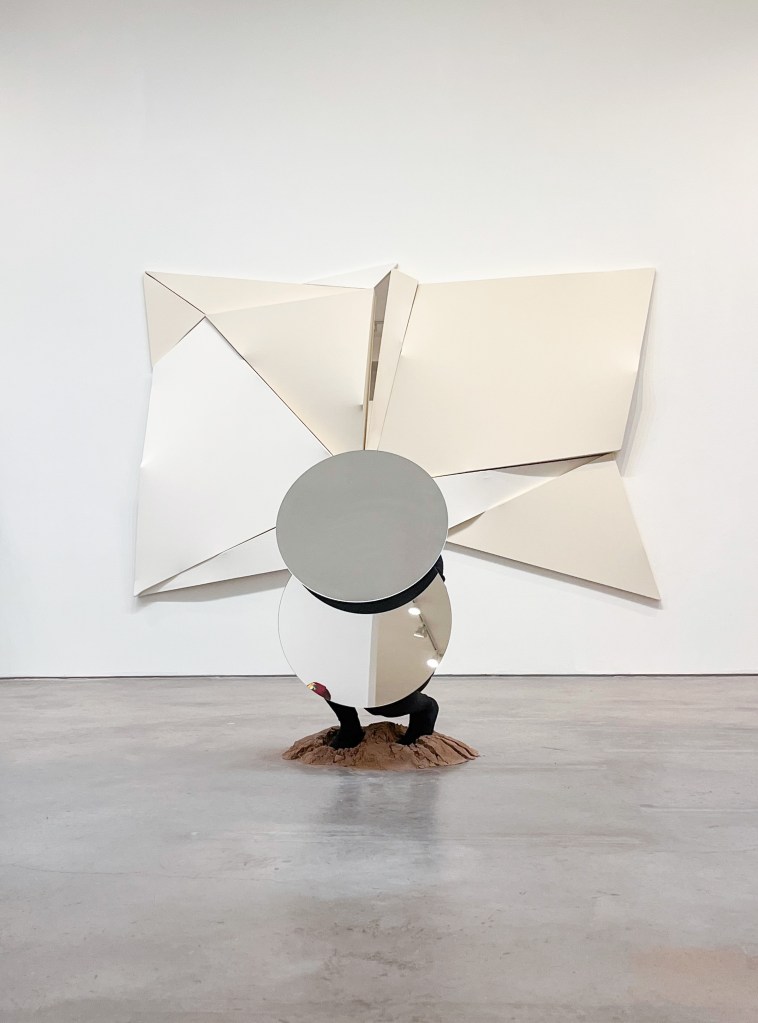
At its core, my practice is an inquiry into edges — both physical and conceptual — and how they frame, define, and limit space. Through shaped and dimensional canvases that extend beyond the traditional rectilinear format, I explore how surfaces can transition from static image to spatial presence, engaging the viewer not just optically, but physically. This investigation is rooted in a historical dialogue with the shaped canvas movement, yet deliberately diverges from its early conventions. Unlike the sensual curves or rigid geometry that characterized much of the early shaped canvas work, my forms are sharper, more unexpected — compositions that maintain a sense of tension and balance, yet resist predictability. The works move between painting and object, drawing attention to the edges as sites of rupture and potential.
Increasingly, I have come to view these works as a kind of mapping — not of geography, but of spatial relationships, emotional orientation, and perceptual thresholds. Like maps, they are abstract systems of navigation, charting both literal and psychological territory. Just as early cartographers worked with incomplete knowledge to render the shape of the world, I use form and material to chart the boundary between what painting has been and what it might still become.
This parallel with mapping connects deeply with a broader human impulse: the need to explore. Whether through geographic expansion, scientific inquiry, or artistic experimentation, exploration is a fundamental expression of our desire to understand — and to expand — the limits of the known. My work channels that drive, pushing the boundaries of pictorial space in pursuit of new spatial vocabularies. It asks: where does a painting end and a sculpture begin? What happens when we no longer accept the edge as an end, but as a beginning?
The most recent body of work marks a move toward radical minimalism and material innovation. Stripping visual elements down to their essence, I focus more intensely on the relationship between borders, surfaces, and the viewer’s physical and perceptual experience. These works, while minimal in form, are maximal in intention — inviting a kind of embodied exploration, a slow navigation of edge, space, and structure.
Ultimately, my practice is a process of charting: of mapping the evolving landscape between disciplines, and of tracing a personal and cultural need to redefine, to cross, and to discover. In this way, the work becomes both artifact and act — a document of where we are, and a gesture toward where we might go.

